

At Atlas, we focus on where the economy is going next, not where it’s been.
That’s the edge.
Most investors are reacting to the macro environment. They are not anticipating it.
They wait for:
Official GDP releases
Lagging economic indicators
Consensus forecasts
By the time the regime is “confirmed,” markets have already moved.
This is why macro investing often feels frustrating:
You’re right… just too late.
The problem is not understanding the macro environment.
It’s timing it.
Where Atlas Fits In
This is where Atlas Analytics changes the equation.
Atlas is a data and signal platform designed to measure economic activity in real time, not months after the fact.
Our models, particularly ROY, translate those signals into shifts in growth and inflation in real time.
That allows us to answer a much more valuable question:
Not “what regime are we in?”
But “what regime are we entering?”
That distinction is everything.
In practice, this means focusing on changes in the trajectory of growth and inflation, not just their levels.
From Signal to Trade
What does this actually look like in practice?
Frequent readers will recall that in January, we flagged a shift in the macro environment.
Using our forward-looking GDP forecasts, we saw:
Economic activity was accelerating relative to consensus
Inflation was proving structurally stickier than expected
This combination pointed to a clear conclusion:
This was not an environment for rate cuts.
It was an environment consistent with higher-for-longer, or even hikes.
And we positioned accordingly.
Those signals translated into positioning:
Short long-duration bonds
Long the U.S. dollar
The result:
iShares 20+ Year Treasury Bond ETF (TLT) has fallen ~5% since its late-February peak
The U.S. dollar has appreciated ~1% YTD
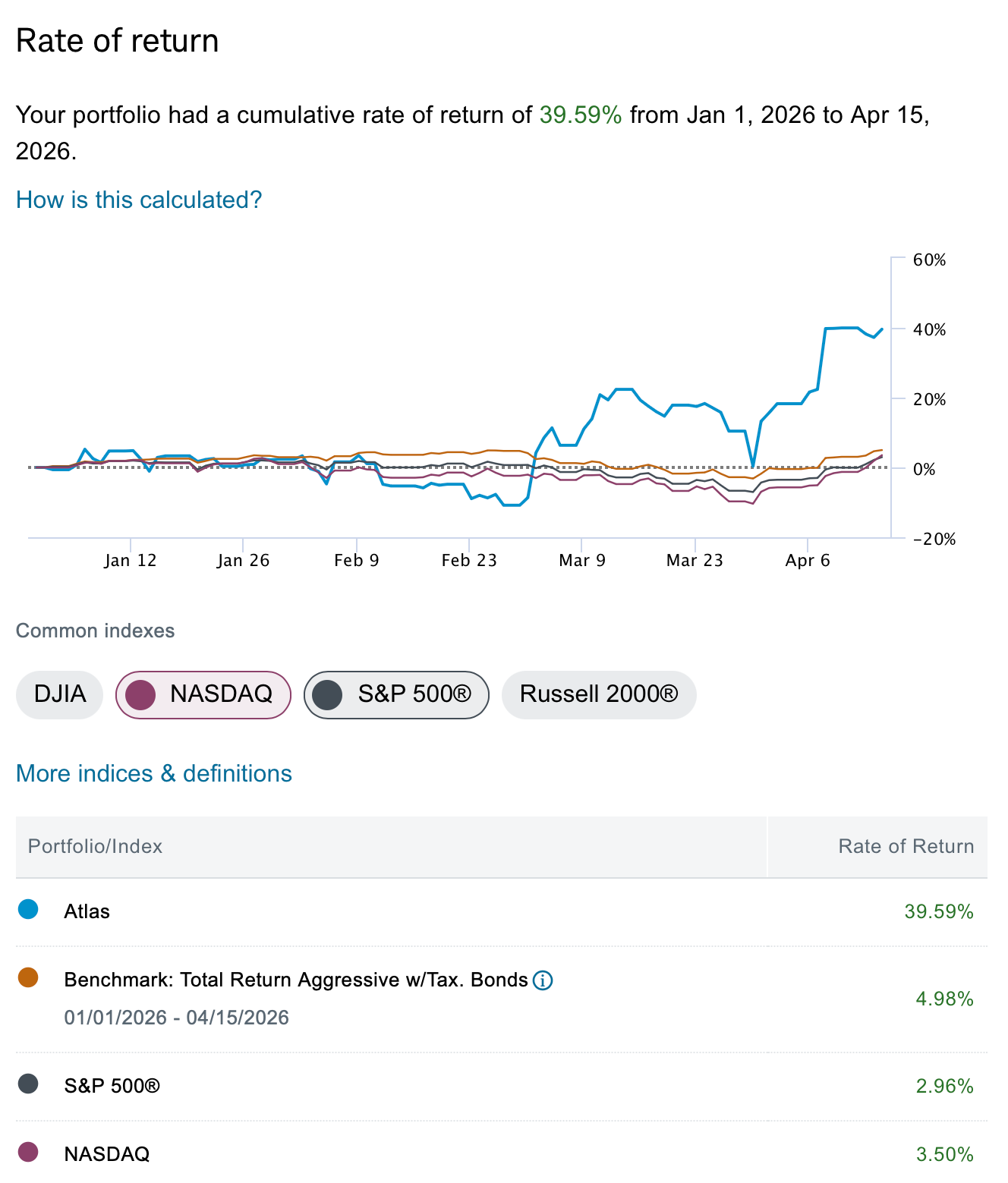
The Atlas Model Portfolio, which reflects how these signals translate in practice, is up approximately +40% YTD, while the NASDAQ is up just ~3.5%.
This wasn’t a discretionary call. It was a direct output of the model’s forward-looking signal.
This is the essence of trading the macro regime:
Identify the shift before it’s visible in official data, position ahead of consensus adjusts, and let the market reprice around you.
The Bigger Game: The Macro Regime
Markets aren’t just mispriced. They also move through regimes.
Periods where the underlying economic environment creates consistent winners and losers.
Think:
Strong growth vs. weak growth
Inflationary vs. disinflationary
Expansion vs. slowdown
Each of these environments rewards a different set of assets.
And crucially:
These regimes persist long enough to be traded.
A Quick Reminder
As a refresher, arbitraging the deviation between fundamental value and market sentiment means identifying when markets are mispriced relative to the underlying economy.
In short, we use our forward-looking GDP estimates to determine where assets should be trading and then compare that to where they are trading.
When there’s a gap, we step in.
But that’s only half the story.
Bringing It Together
The Atlas Model Portfolio is built on two distinct sources of alpha:
Arbitraging the deviation between fundamental value and market sentiment
Trading the macro regime
The combination of these two approaches, exploiting mispricing and anticipating the macro environment, is what has driven that performance.
One is about valuation.
The other is about direction.
Together, they allow investors to generate alpha across environments, not just when markets are obviously wrong.
Macro doesn’t have to be reactive. It can be traded proactively, if you have the data.
Final Thought
Most investors are trying to answer:
“What just happened?”
We’re focused on a different premise:
What’s about to happen and how do we position before it does.
That’s the edge.
What’s Next
Next week, Atlas will go public with the data we’ve been sharing privately with clients over the past three months:
Our Q1 2026 GDP estimate.
Curious?
Tune in next week for our YouTube release breaking down the data and what it means for markets.
In the meantime, if you’re interested in using Atlas data to inform your investment strategy, feel free to reach out.