

Two weeks ago, I introduced Atlas Analytics’ contrarian macro thesis.
As a reminder, I wrote:
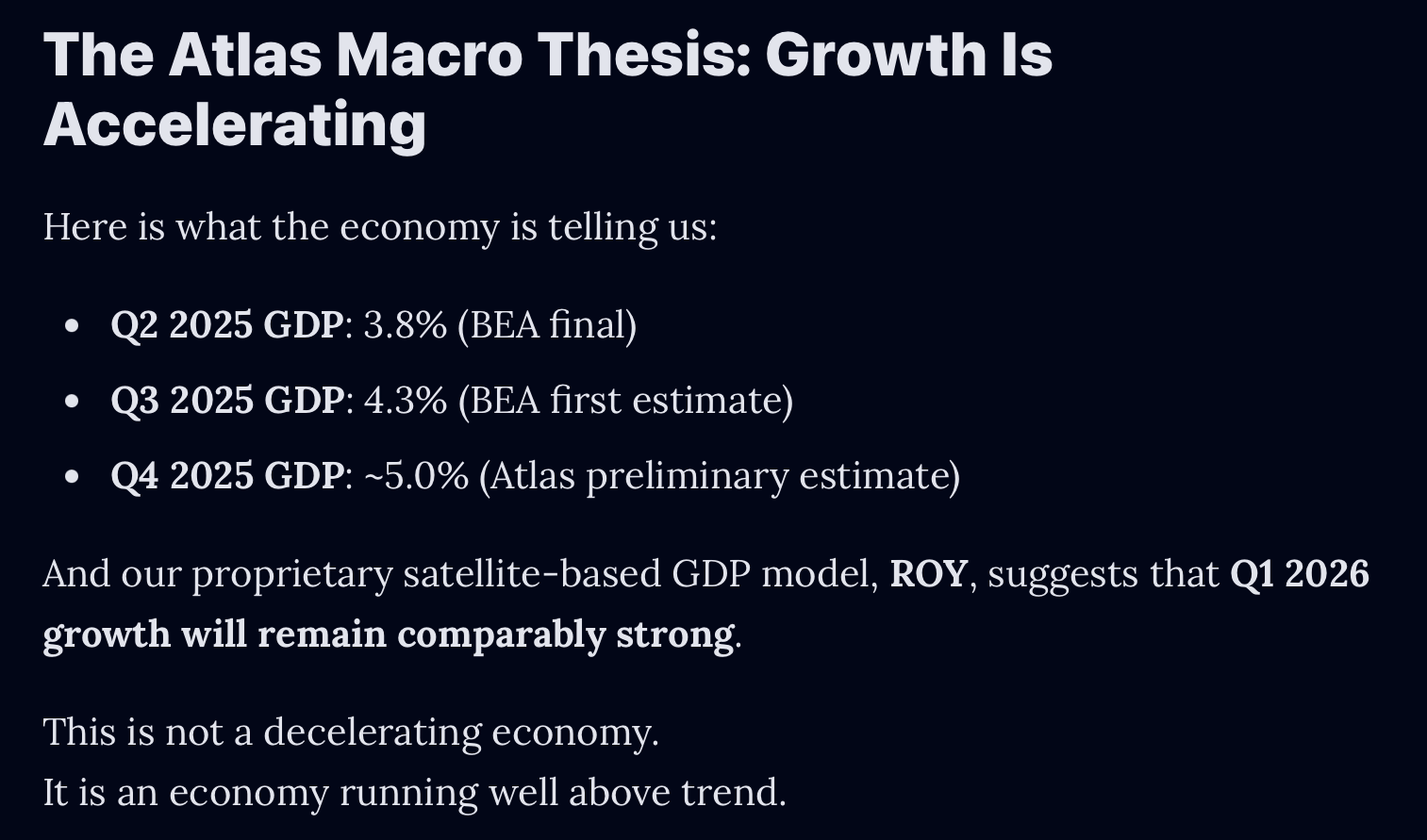
Recall that up until that point, the consensus belief was: growth is slowing and the Fed will continue to cut.
On Wednesday, Jerome Powell, the Federal Reserve Chairman, paused – just as Atlas has been discussing with our clients.
Here’s where our view diverges even further from the consensus.
Instead of continuing to cut, as the market is pricing in throughout 2026, we see short-term rates going higher – not lower.
A Hawkish Pause?
Powell’s pause was broadly interpreted as benign. Markets barely reacted, and expectations for rate cuts remain firmly in place—if not at the March FOMC, then later this year.
But buried in the Q&A was a subtle shift.
In response to a question, Powell replies:
“The outlook for economic activity has improved… growth is on a solid footing,” and that while the risks to inflation and employment have diminished, they still exist — indicating that future rate moves will be driven by incoming data, not prior expectations.
Not prior expectation, but incoming data will drive future rate moves.
And Atlas Analytics knows that the incoming data will be strong.
The Interest Rate Corollary (Again)
As I wrote in my note Trump’s Challenge Leaves the Federal Reserve At A Crossroads two weeks ago: The corollary to strong incoming data is higher longer-term rates.
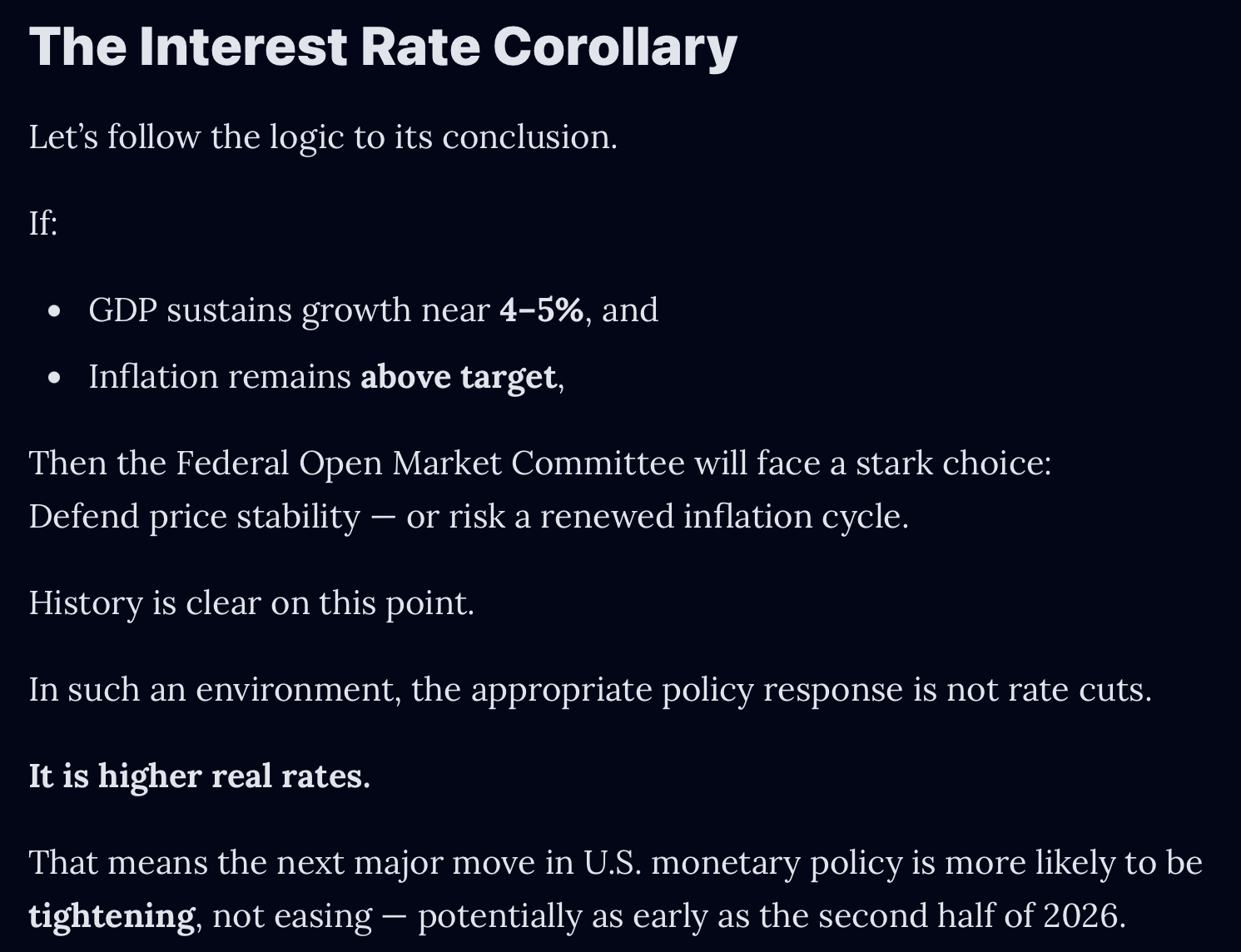
Not today, not next month, but – if the data comes in as strong as we expect – the conversation in the FOMC will shift by the summer, introducing the possibility of a rate hike in the fall of 2026 or the winter of 2027.
Atlas’ Preliminary Longer-Term Economic Forecast
So what is our satellite-powered GDP data showing – that the market and the FOMC doesn’t yet know.
Since Q1 2025’s slightly negative print, GDP growth has reaccelerated sharply.
Our satellite data points to approximately +5.0% growth in Q4 2025. While the official advance release was delayed by last fall’s government shutdown, the quarter is complete and the signal is already clear.
Looking ahead, we estimate Q1 2026 growth at roughly +4.5%, ahead of its expected late-April release.
If these estimates are even close, the implication is significant. U.S. growth is materially stronger than the market expects, and interest rates will need to move higher to contain inflationary pressure.
(We’ll be releasing our Q4 2025 video on our YouTube channel on Sunday, February 15th).
Atlas’ Preliminary Longer-Term Rate Forecast
What might the Federal Funds Rate look like if indeed growth is too strong and inflation too sticky?
The result: A policy rate surprise.
Using an applied Taylor Rule (a method that combines inflation and growth rates to arrive at the proper interest rate-level), and then augmenting it for a likely – but not guaranteed – hiking cycle, Atlas Analytics arrives at the chart below.
In plain terms: if growth and inflation evolve as our data suggests, today’s policy stance becomes accommodative—not restrictive—by late 2026.
If growth holds near +4–5% through mid-2026, the first serious discussion of hikes likely emerges in the second half of the year.
In our view, and without anchoring to precise timing, the implication of this chart is a Federal Funds Rate closer to 5.0% than 3.1%, the value proposed by the FOMC’s own Summary of Economic Projections.
What Does This Mean For You?
This is the type of insights made possible through Atlas Analytics’ satellite-based real-time GDP forecasts. We share these insights weekly with our clients so they can get ahead of the market.
While we are currently focused on the United States, Atlas’ mission is to bring satellite-based, real-time GDP insights to every country on Earth.
Whether you are an institutional investor, family office, government agency, or international organization, Atlas provides world-class macro data, financial targets, and economic insight. Reach out to learn more.
Bonus for Our Paid Subscribers: How to Trade This
If our thesis is correct—stronger-than-expected growth, stickier inflation, and a higher terminal policy rate—the implications for asset prices are asymmetric.
Below are three ways to position for a policy rate surprise.
