

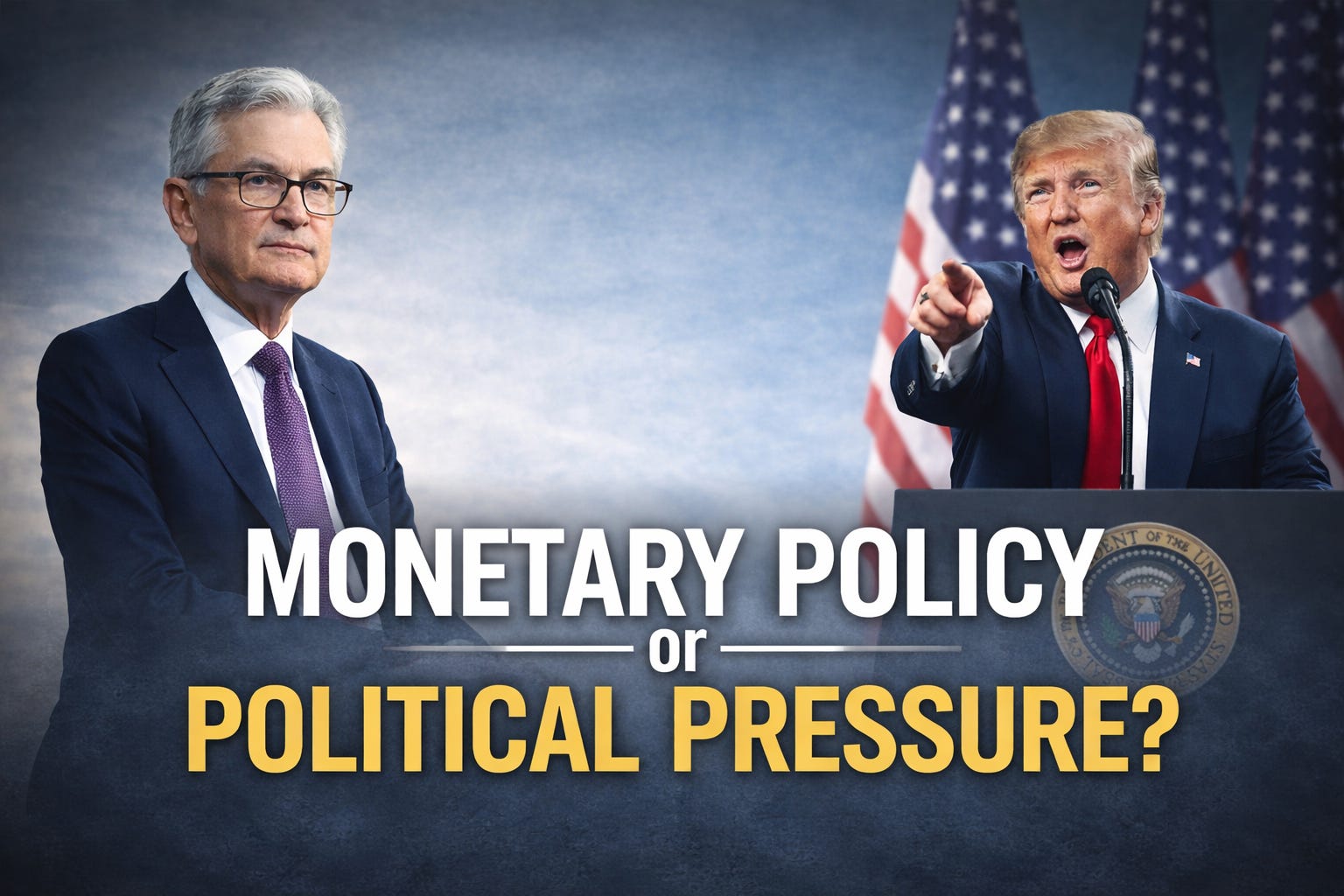
Last Sunday, Federal Reserve Chair Jerome Powell did something rarely seen from a sitting central banker: he publicly drew a line.
In a public statement responding to growing political pressure tied to “construction costs” and broader policy grievances, Powell made his position unmistakable:
This isn’t about renovations or testimony. It’s about whether monetary policy will be set by economic evidence — or by political intimidation.
That distinction matters more than most market participants currently realize.
Beneath the headlines lies a much larger story — one with direct consequences for interest rates, inflation, and U.S. economic growth in 2026 and beyond.
Powell’s stance matters because the economic backdrop he is responding to is very different from what markets currently assume.
The Consensus View — and Why It’s Wrong
The prevailing market thesis is simple:
Growth slows
Inflation fades
Rates fall through 2026
At Atlas Analytics, we believe the opposite is increasingly likely.
Not because of ideology — but because the data no longer support the consensus narrative.
The Atlas Macro Thesis: Growth Is Accelerating
Here is what the economy is telling us:
Q2 2025 GDP: 3.8% (BEA final)
Q3 2025 GDP: 4.3% (BEA first estimate)
Q4 2025 GDP: ~5.0% (Atlas preliminary estimate)
And our proprietary satellite-based GDP model, ROY, suggests that Q1 2026 growth will remain comparably strong.
This is not a decelerating economy.
It is an economy running well above trend.
The independent real-time nowcasts from the Atlanta Fed’s GDPNow for Q4 (5.3% as of January 14) corroborates Atlas’ economic picture. Yet markets continue to price a slowdown that has yet to materialize.
Inflation Isn’t Gone — It’s Sticky
December CPI tells the second half of the story.
At 2.7% year-over-year, inflation is not surging — but it is clearly above the Fed’s 2% target, and far from conclusively defeated.
With growth accelerating and demand remaining firm, inflation risks are asymmetric to the upside.
This places the Federal Reserve squarely back at the fulcrum of its dual mandate:
Full employment remains resilient.
Price stability is increasingly fragile.
In that configuration, the policy implication is not easing.
It is restraint.
The Interest Rate Corollary
Let’s follow the logic to its conclusion.
If:
GDP sustains growth near 4–5%, and
Inflation remains above target,
Then the Federal Open Market Committee will face a stark choice:
Defend price stability — or risk a renewed inflation cycle.
History is clear on this point.
In such an environment, the appropriate policy response is not rate cuts.
It is higher real rates.
That means the next major move in U.S. monetary policy is more likely to be tightening, not easing — potentially as early as the second half of 2026.
A Historical Parallel: The Mid-1990s
The closest modern analogue may be the mid-1990s under Chairman Alan Greenspan (my first boss), when the Fed engineered one of the few genuine soft landings in U.S. history.
During that period:
Growth remained strong
Inflation risks were contained only through disciplined policy
The average effective federal funds rate was 5.3%
Today, the effective rate sits near 3.6% — materially below that historical benchmark, despite an economy that may be running just as hot.
Somewhere between those two numbers lies a more realistic equilibrium.
The lesson from the mid-1990s is that strong growth required higher policy rates than today’s to sustain a soft landing.
Why Politics Now Matters More Than Ever
This brings us back to the emerging tension between the White House and the Federal Reserve.
For more than a century, central bank independence has been a cornerstone of U.S. economic credibility, anchoring inflation expectations, stabilizing markets, and insulating monetary policy from short-term political incentives.
That independence is now being openly tested.
The outcome will not merely shape the next election cycle.
It will shape the trajectory of U.S. growth, inflation, and financial stability for decades.
The Atlas View
At Atlas Analytics, our position is clear.
Not politically — but economically.
In an environment of accelerating growth and persistent inflation risk, interest rates should be higher — and policy should remain firmly insulated from political pressure.
Supporting Federal Reserve independence today is not about personalities.
It is about preserving the institutional framework that made long-run American prosperity possible.
Call to Action
This is not just a macro opinion — it’s a positioning framework.
At Atlas Analytics, we use satellite-derived GDP nowcasting and proprietary AI models to help investors anticipate policy inflection points before markets price them in.
If you want to trade this thesis — or stress-test it against your own — we’d welcome the conversation.