

Five months ago, in Big Trouble for Big Tech, we argued that technology stocks—particularly the Technology Select Sector SPDR ETF (XLK)—had become increasingly disconnected from underlying economic fundamentals. Our proprietary valuation models suggested that technology equities were trading substantially above the levels justified by economic activity.
Four months ago, in Big Trouble for Big Tech, Part II, we expanded that analysis to the broader equity market. We found that overvaluation was not confined to technology. Across most of the major ETFs we examined, market prices appeared to reflect expectations for a substantially stronger economy than the one our models were observing.
Just last week, in Q3 GDP: Why We Expect a Downward Revision, we argued that the Bureau of Economic Analysis’s advance estimate of 3.4% annualized GDP growth likely overstated the underlying strength of the U.S. economy. We anticipate that subsequent revisions will bring growth closer to 2.4%.
Is this the week those warnings are finally being vindicated?
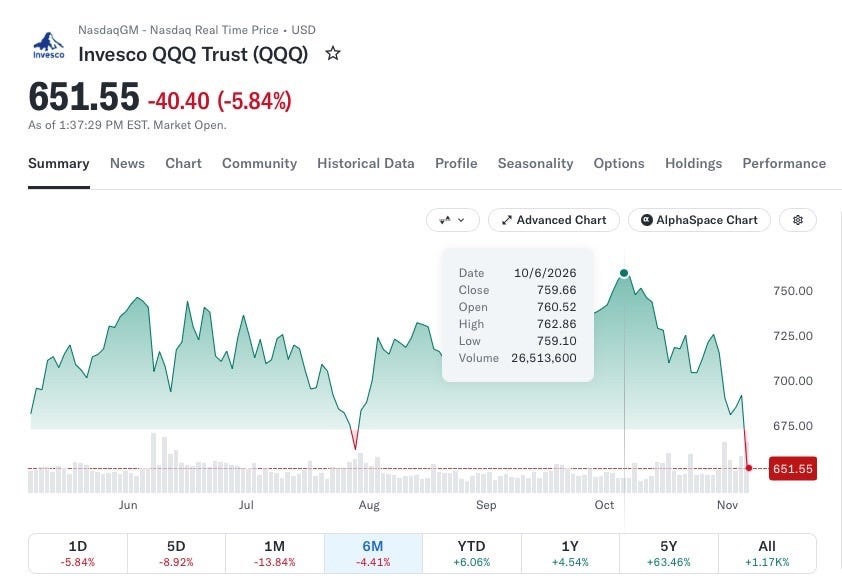
Since October 6, the Invesco QQQ Trust (QQQ), which tracks the Nasdaq-100, has experienced a remarkable reversal. What began as a retreat from record highs has become an increasingly severe selloff, particularly among semiconductor manufacturers and companies exposed to artificial intelligence infrastructure.
Last Friday, technology and semiconductor stocks experienced another sharp decline. This Thursday, the rout deepened dramatically, with the Philadelphia Semiconductor Index falling by as much as approximately 11% intraday and the Nasdaq Composite entering correction territory.
The selling has increasingly spread beyond technology, raising concerns about the broader equity market.
For investors confronting these losses, three questions naturally arise:
Why the fall? Why now? And what comes next?
We believe the answers lie in the convergence of three forces: weakening underlying economic growth, the increasingly debt-financed expansion of data-center infrastructure, and interest rates that remain elevated relative to the expectations embedded in technology valuations.
1. Why the Fall? The Straws That Broke the Camel’s Back
A. GDP: The Economy May Be Weaker Than Investors Believe
The first source of concern is the underlying economy itself.
As we discussed last week, the BEA’s advance estimate showed U.S. real GDP expanding at a robust 3.4% annualized rate in Q3 2026.
Our original Atlas forecast was substantially weaker, at 1.5%. Although we now anticipate that subsequent revisions will bring the official figure closer to 2.4%, the central conclusion remains: the economy may not be growing as quickly as the headline statistics suggest.
Two components of GDP are particularly concerning.
First, we believe personal consumption has been overstated. Consumer spending accounts for approximately two-thirds of U.S. GDP, and even relatively modest downward revisions can materially affect headline growth.
Second, international trade continues to deteriorate.
Our proprietary JACK algorithm, which uses satellite imagery and computer vision to monitor physical trade activity, has consistently identified weakness in net exports.
The latest official trade statistics reinforce this concern.
According to the BEA and Census Bureau’s balance-of-payments data, the U.S. goods-and-services trade deficit reached approximately $105 billion in September 2026, a historically large monthly shortfall.
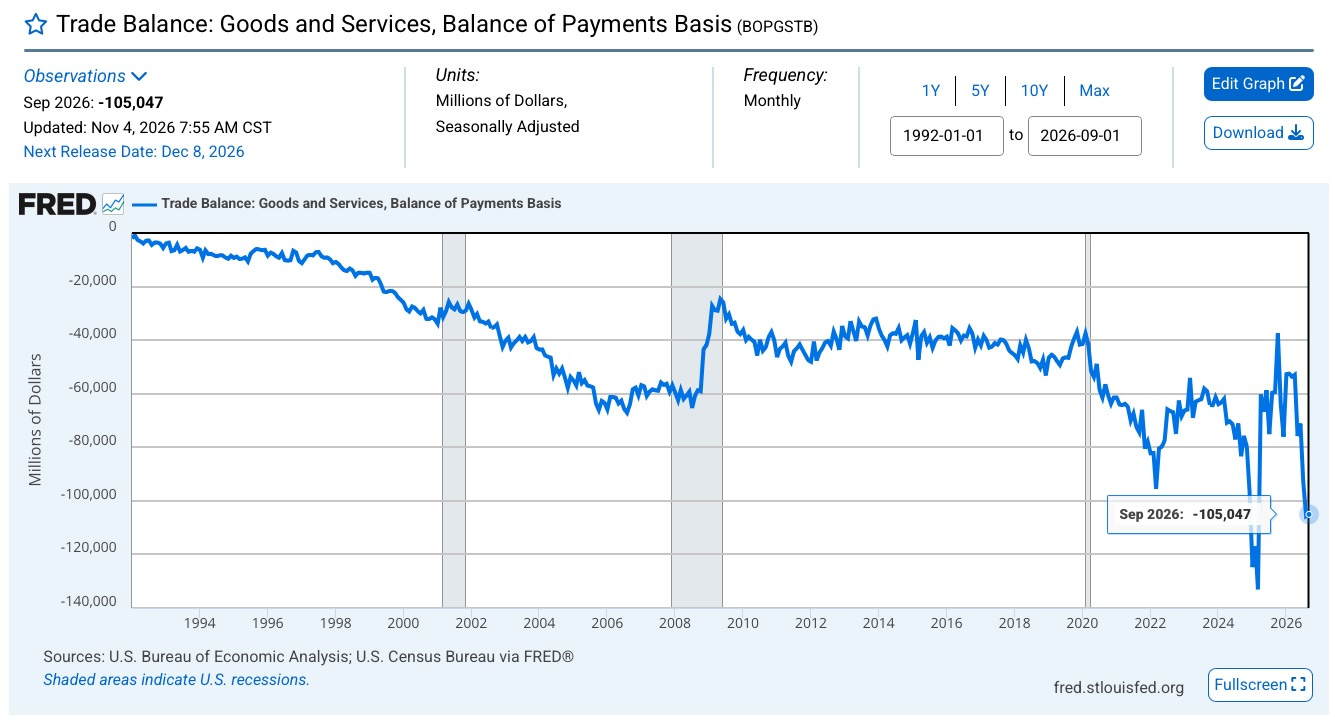
Figure 2: U.S. Trade Balance, 1992–2026. The U.S. trade deficit widened to $105 billion in September, reinforcing concerns about weakening net exports and underlying GDP growth.
This deterioration is particularly concerning because it occurred during the third quarter, the same period for which the BEA initially reported 3.4% GDP growth.
To be clear, nominal trade deficits cannot be translated directly into real GDP contributions. The composition of imports and exports, price adjustments, and quarterly changes all matter.
Nevertheless, the magnitude of the deterioration is consistent with the weakness our satellite-based indicators have identified.
Our historical analysis also suggests that investors should not place excessive confidence in preliminary GDP releases. We estimate that the BEA’s second revision differs from the advance estimate by approximately 0.7 percentage points on average in absolute terms.
A downward revision of the magnitude we anticipate would therefore be meaningful, but not unprecedented.
Why does this matter for technology stocks?
In our previous research, we introduced what we call the invisible tether: the relationship between aggregate economic activity and equity valuations.
Over the long run, corporate revenues, earnings, and cash flows cannot become permanently disconnected from the economy that supports them.
If the market is pricing technology companies on the assumption of accelerating economic growth, but the underlying economy is instead moderating, that disconnect becomes increasingly difficult to sustain.
The first straw, therefore, is the possibility that investors have been paying for economic growth that is not actually materializing.
B. Data-Center Debt: The AI Boom’s Growing Financial Vulnerability
The second concern is more specific to technology: the extraordinary scale of capital investment required to support artificial intelligence.
Over the past several years, the AI investment boom has helped sustain demand for semiconductors, servers, networking equipment, electricity infrastructure, and data-center construction.
This spending has been a genuine source of economic strength.
But the financing model supporting that expansion deserves closer scrutiny.
Building modern AI infrastructure is enormously capital-intensive. Companies must invest in land, buildings, power infrastructure, advanced semiconductors, cooling systems, and networking equipment—often well before the facilities generate sufficient revenue to justify their construction.
Increasingly, portions of this expansion are being financed through corporate borrowing, project-level debt, and other financing arrangements.
That creates an important distinction between investment that is supported by realized demand and investment that depends on expectations of future demand.
There is nothing inherently problematic about borrowing to finance productive investment. Debt can be an efficient way to fund infrastructure that generates durable cash flows.
The vulnerability emerges when the cost of capital rises, expected returns decline, or projects fail to generate revenues on the timelines investors anticipated.
For data centers, this risk is particularly important.
Unlike many traditional infrastructure assets, AI computing equipment can become technologically obsolete relatively quickly. The useful economic life of advanced semiconductors may be considerably shorter than that of the buildings and power systems housing them.
Consequently, investors must consider not only whether AI demand will continue to grow, but whether that growth will be sufficient to justify the enormous capital expenditures being undertaken today.
If expected returns disappoint, the consequences could extend beyond the balance sheets of individual technology companies.
A slowdown in data-center construction would reduce demand for equipment, structures, and related infrastructure. That, in turn, could weaken fixed investment—one of the components currently supporting U.S. GDP growth.
This creates a potentially self-reinforcing relationship:
Slower growth → weaker expected AI revenues → tighter financing conditions → reduced capital expenditure → slower GDP growth.
The irony is difficult to ignore.
The very investment boom that has helped sustain economic growth could become a source of economic weakness if financing conditions deteriorate.
We are not arguing that such a reversal is inevitable. The long-term productivity potential of artificial intelligence remains substantial.
But investors should distinguish between the transformative potential of a technology and the financial returns earned by companies investing in it.
The internet ultimately transformed the global economy. That did not prevent investors from suffering enormous losses when technology valuations collapsed in 2000–2002.
The same distinction matters today.
C. Rising Rates: The Cost of Capital Matters Again
The third concern is the interest-rate environment.
As we argued in our October article, Higher for Longer: Why the Market Still Underestimates the Fed, we believe investors continue to underestimate the persistence of inflation and the likelihood that the Federal Reserve will maintain a more restrictive monetary policy than markets anticipate.
Our expectation remains that the federal funds rate will approach 5% over the medium term, substantially above the path investors had grown accustomed to during the era of exceptionally cheap money.
This matters enormously for technology equities.
Growth stocks are particularly sensitive to interest rates because a disproportionate share of their valuations reflects expected earnings and cash flows many years into the future.
When discount rates rise, the present value of those future cash flows falls.
Consider a company whose market valuation depends on profits expected to materialize over the next decade. Even if those future profits remain unchanged, a higher required rate of return can substantially reduce the company’s present valuation.
The implications extend beyond equity prices.
Higher borrowing costs also affect the economics of data-center development.
Projects financed with debt must generate sufficient returns to cover interest expenses, repay principal, and compensate equity investors for their risk.
As financing costs increase, projects that appeared attractive under lower-rate assumptions may become less economically viable.
This is particularly consequential for infrastructure investments whose revenues remain uncertain or several years away.
The Federal Reserve’s policy path therefore matters through two distinct channels: the valuation of future earnings and the cost of financing the investment required to generate those earnings.
Importantly, as we explained in Higher for Longer, a hawkish Federal Reserve does not necessarily imply that long-term Treasury yields must continue rising.
Indeed, we have argued that long-duration Treasuries may already be oversold, even as we anticipate a higher federal funds rate.
The relationship between short-term policy rates and long-term yields depends on expectations for future inflation, economic growth, and monetary policy. A weaker growth outlook could place downward pressure on long-term Treasury yields even if the Fed maintains a restrictive policy stance.
The relevant concern is not simply whether the Fed raises rates at its next meeting. It is whether financing costs remain higher for longer than investors and borrowers have assumed.
In that environment, richly valued technology companies face pressure from both sides of the equation: lower present values for expected future earnings and potentially weaker returns on capital-intensive investment.
The third straw is that an expensive investment boom becomes much harder to justify when money itself is expensive.
2. Why Now? When Expectations Meet Reality
None of these risks emerged overnight.
Economic growth has been uneven for several quarters. Technology valuations have remained elevated for months. Data-center capital expenditure has been expanding rapidly, and borrowing costs have been a persistent concern.
So why has the market begun repricing these risks now?
We believe the answer lies in the interaction between expectations, financing conditions, and a sudden reassessment of the outlook for AI infrastructure.
Markets do not require economic conditions to become objectively poor before prices decline. They need only conclude that the future is likely to be less favorable than previously anticipated.
For much of 2026, technology investors appeared willing to overlook elevated valuations because they expected AI adoption, infrastructure investment, and future earnings growth to justify today’s prices.
But as capital expenditure commitments expand, investors are increasingly asking when those investments will generate adequate returns.
The November midterm elections have introduced another source of uncertainty. Political opposition to data-center expansion, including concerns about electricity costs, water consumption, and local infrastructure, has raised questions about the pace at which planned facilities can be completed.
Recent selling in semiconductor and AI infrastructure companies suggests that investors are reassessing not only the profitability of AI spending, but also whether the projected infrastructure expansion can proceed on its original timetable.
This matters because the AI investment ecosystem is highly interconnected.
Semiconductor manufacturers depend on demand from data-center operators and hyperscalers. Those operators depend on access to capital, electricity, and suitable development sites. Their financing ultimately depends on expectations for future computing demand and profitability.
A disruption anywhere along this chain can affect valuations throughout the sector.
These developments do not necessarily mean that the AI investment cycle has peaked.
They do suggest that the market is becoming less willing to capitalize distant, uncertain earnings at exceptionally generous valuations.
This is precisely the vulnerability we identified in our earlier research.
Our argument was never that artificial intelligence lacks economic value. It was that equity prices had moved substantially ahead of the economic fundamentals needed to justify them.
When expectations are sufficiently elevated, even modest disappointments can produce substantial price declines.
3. What Comes Next? Three Possible Paths
We see three broad possibilities for the technology sector and the wider equity market.
Scenario 1: A Healthy Correction
The most favorable outcome is that the recent selloff represents a relatively orderly adjustment in valuations.
Under this scenario, AI investment continues, corporate earnings remain resilient, and the economy avoids a significant slowdown.
Technology stocks stabilize at more reasonable valuations, allowing earnings growth to gradually close the gap between market prices and economic fundamentals.
This outcome remains plausible, particularly if AI adoption translates into sustained productivity improvements and stronger corporate cash flows.
Scenario 2: A Prolonged Repricing
A second possibility is that valuations continue to decline as investors reassess the pace and profitability of AI investment.
In this scenario, technology companies may continue expanding their infrastructure, but investors become less willing to pay extraordinary multiples for future earnings.
The correction could therefore persist even without a recession or a collapse in AI spending.
For investors, this distinction is important: a company can remain operationally successful while its stock price declines substantially.
Scenario 3: A Broader Economic Feedback Loop
The most concerning possibility is that the technology correction begins to affect the real economy.
If financing conditions tighten materially, some data-center developers could delay or cancel projects.
Reduced investment would weaken demand for semiconductors, construction, equipment, and related services.
If this occurs alongside moderating consumer spending and deteriorating net exports, the consequences could extend beyond the technology sector.
In this scenario, the relationship between markets and economic activity becomes mutually reinforcing.
Falling valuations reduce access to capital. Reduced access to capital constrains investment. Lower investment weakens GDP growth, which places further pressure on corporate earnings and valuations.
This is the scenario we believe investors should monitor most carefully heading into 2027.
It is not our base-case forecast at present, but the combination of elevated valuations, concentrated capital expenditure, and increasingly complex financing arrangements makes it a risk worth taking seriously.
The Bottom Line
For several months, Atlas Analytics has argued that technology equities, and increasingly the broader market, were trading at valuations difficult to reconcile with underlying economic activity.
This week’s selloff suggests that investors may finally be reconsidering some of the assumptions supporting those valuations.
But the more important question is whether the correction has adequately accounted for the risks ahead.
We see three interconnected vulnerabilities: an economy that may be growing more slowly than official preliminary statistics suggest, an AI infrastructure boom increasingly exposed to financing risk, and an interest-rate environment that challenges both equity valuations and capital investment.
Individually, none of these forces necessarily implies a prolonged market downturn.
Together, they create the possibility of a more consequential repricing.
The long-term economic potential of artificial intelligence remains enormous. But technological transformation does not guarantee attractive investment returns, particularly when expectations have already been capitalized into equity prices.
Our earlier articles asked whether markets had become disconnected from the economy.
The question now is whether that disconnect is finally beginning to close—or whether the adjustment has only just begun.
Atlas Analytics develops proprietary macroeconomic indicators, economic forecasts, and financial valuation models using satellite imagery, computer vision, and advanced statistical methods.
Atlas Analytics | Atlas Analytics Research
Disclaimer: This article reflects economic forecasts and market analysis, not personalized investment advice. Forecasts and valuation estimates are subject to uncertainty and revision.