

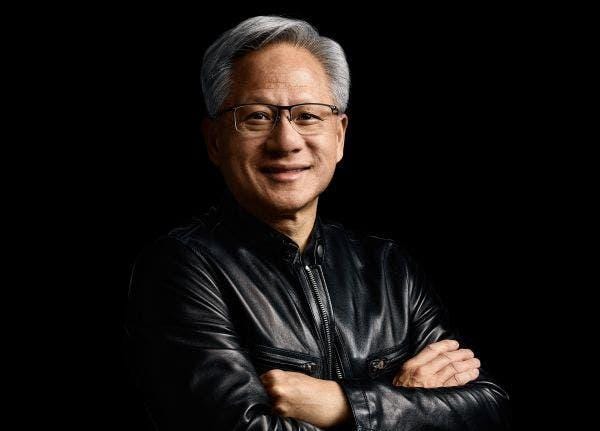
Few executives have become as synonymous with an economic transformation as Jensen Huang has with artificial intelligence.
On Thursday, Huang resigned as CEO of Nvidia, the semiconductor giant he co-founded more than three decades ago, following a rapidly escalating controversy involving his personal conduct and national security concerns. Nvidia appointed longtime CFO Colette Kress as interim CEO.
His departure has sent shockwaves through financial markets, raising questions that extend far beyond the leadership of a single company.
For months, Atlas Analytics has warned in our Big Trouble for Big Tech series that technology valuations have become increasingly disconnected from underlying economic fundamentals.
Huang’s departure raises an uncomfortable question: Has the AI investment boom become too dependent on one man, one company, and one extraordinary cycle of capital expenditure?
1. A Cult of Personality
Few corporate leaders have commanded the influence Huang enjoyed.
With his signature leather jacket, charismatic presentations, and relentless advocacy for accelerated computing, Huang became the public face of the AI revolution.
Under his leadership, Nvidia evolved from a graphics-chip manufacturer into one of the world’s most valuable companies and the dominant supplier of computing infrastructure powering modern artificial intelligence.
But the extraordinary concentration of influence around Huang also created vulnerabilities.
Investors were not merely betting on Nvidia’s technology. They were betting on Huang’s vision, his relationships, and his ability to orchestrate an increasingly complex ecosystem of suppliers, customers, and financial partners.
His departure does not invalidate the technological promise of artificial intelligence. Nvidia retains substantial intellectual property, engineering expertise, and commercial relationships.
Nevertheless, it illustrates the danger of allowing confidence in a visionary leader to become inseparable from confidence in an entire investment thesis.
A technological revolution can outlast its most celebrated champion. Its equity valuations may prove less resilient.
2. The AI Financial Machine
Nvidia occupies a remarkable position at the center of the AI economy.
Technology giants and specialized cloud providers are spending extraordinary sums constructing data centers, purchasing advanced semiconductors, and expanding computing capacity.
Much of that expenditure ultimately flows toward Nvidia and its semiconductor ecosystem.
But Nvidia’s role extends beyond supplying chips.
The company has also invested in businesses that purchase its products, creating financial relationships in which the supplier can simultaneously become an investor in its customers.
Such arrangements are not inherently problematic. They can accelerate technological adoption and help promising businesses expand.
However, they raise questions about the independence and sustainability of demand.
When suppliers help finance their customers, how much of today’s revenue reflects sustainable end-user demand, and how much depends on continued access to capital?
The distinction matters enormously.
Semiconductor manufacturers recognize revenue when they sell equipment. Data-center operators, meanwhile, must generate sufficient future cash flows to justify the enormous investments required to purchase and operate that equipment.
If those returns disappoint, today’s extraordinary capital expenditure could become tomorrow’s financial vulnerability.
3. The Macroeconomic Question: Is the Boom Sustainable?
The implications extend well beyond Silicon Valley.
Data-center construction, computing equipment, and associated infrastructure have become important sources of U.S. investment activity.
But increasingly capital-intensive development requires financing, and financing depends on interest rates, investor confidence, and expectations for future returns.
As we argued in Higher for Longer, we believe monetary policy could remain more restrictive than markets anticipate.
If financing conditions tighten, some planned data-center projects may become uneconomic. Investment could slow, weakening a component of GDP that has helped support economic growth.
This would be particularly concerning if consumer spending and international trade also weaken, as our satellite-based indicators suggest.
A Storm Is Brewing
Huang’s departure may ultimately prove to be a temporary disruption in an otherwise durable technological revolution.
But it also provides an opportunity to examine the financial foundations supporting that revolution.
Next week, in A Storm Is Brewing, Atlas Analytics will investigate three questions: How much debt is financing America’s data-center boom? How much is that investment contributing to U.S. GDP? And what could a pullback mean for economic growth in 2027?
Artificial intelligence may transform the global economy. Whether today’s extraordinary investment boom can sustain itself is an entirely different question.
Atlas Analytics develops proprietary macroeconomic indicators and forecasts using satellite imagery, computer vision, and advanced statistical modeling.
Disclaimer: The views expressed are subject to uncertainty and do not constitute investment advice.