

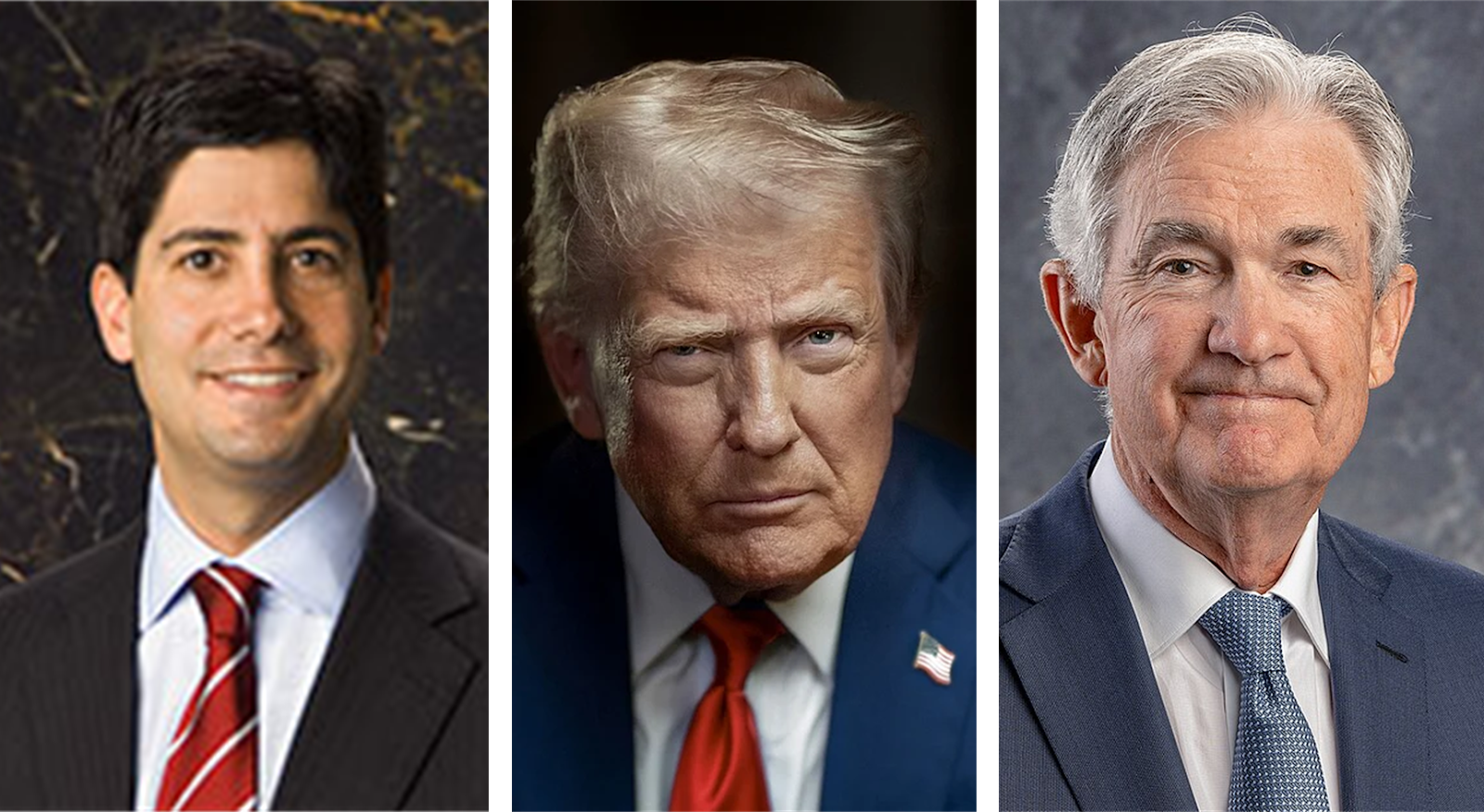
TLDR: A shift from Powell to Warsh signals a move toward tighter, more preemptive Fed policy, with direct implications for rates, asset prices, and portfolio positioning.
As Jerome Powell’s time as Chair of the Federal Reserve comes to an end on May 15, the anticipated confirmation of nominee, former Fed Governor Kevin Warsh, marks more than a standard leadership change at the Federal Reserve.
It signals a potential shift in how rates are determined and executed. Both Powell and Warsh are nominees of President Donald J. Trump but it is unclear what type of Chair Warsh will be should the Senate confirm his nomination.
Although a Senate Banking Committee confirmation is expected in the coming weeks, a paved path does not lie ahead of Warsh. It is anticipated that he will face rigorous questions on central bank digital currencies (CBDCs), federal debt, and how he will maintain Fed independence coming off of Powell’s term that reflected an administration that hurled insults and launched a federal investigation when Powell did not lower rates.
Is Warsh still a “Hawk”?
Kevin Warsh previously served on the Federal Reserve Board of Governors from Feb. 24, 2006, to March 31, 2011 during the financial crisis of 2008 and remains a long-standing critic of the Fed’s post-crisis policy record.
Warsh acted as the bank’s primary liaison to Wall Street and as the Fed’s representative to the Group of Twenty (G20). His career began as Special Assistant to former President George W. Bush at the White House. Bush’s nomination of Warsh drew criticism as he was the youngest appointment in the history of the Fed.
The difference between Powell’s framework and what a Warsh-led Fed could look like is not theoretical. It shows up clearly in how inflation, rates, and policy responses have evolved in recent years.
This dynamic helps explain why a shift toward a more preemptive Fed would represent a meaningful change in how markets interpret policy signals.
From “Flexible” to “Reform”
Powell’s Fed embraced flexibility. Under Powell’s leadership, the central bank formally shifted to an average inflation targeting framework, allowing inflation to run above 2% for some time following periods of undershooting. This framework justified patience in tightening, even as inflation began to accelerate in 2021.
Warsh, by contrast, has consistently warned about the long-term costs of easy money, particularly on its impact on financial stability and asset prices. If he brings that philosophy to the chair, the Fed could move toward a more preemptive posture: quicker to tighten, less tolerant of inflation overshoots, and more focused on maintaining credibility with markets.
In practical terms, that could mean:
Potentially Higher Rates: Warsh’s Fed may have lower tolerance for upward inflationary pressure
Likely More Positive Real Rates: Greater emphasis on real rates (the policy rate after inflation) staying positive
More Opaque: Less reliance on forward guidance as a policy tool
Balance Sheet Policy Back in Focus
Another likely shift is the role of the Fed’s balance sheet. Powell oversaw an era of massive expansion, first through quantitative easing and later through emergency liquidity facilities.
Warsh has been openly critical of the Fed’s footprint in financial markets. His leadership could accelerate balance sheet normalization, both in pace and in principle. The Fed might become more reluctant to intervene in market functioning unless absolutely necessary, raising the bar for future liquidity programs.
That has implications not just for rates, but for risk assets broadly. A smaller, less active Fed balance sheet typically translates into tighter financial conditions, even absent explicit rate hikes.
Perhaps the most immediate change would come in how the Fed communicates.
Powell evolved into a highly transparent chair, using press conferences, speeches, and clear forward guidance to shape market expectations. This approach reduced volatility at times, but also risked locking the Fed into specific policy paths.
Warsh is likely to favor more ambiguity. Historically, he has argued that excessive transparency can weaken policy effectiveness by encouraging markets to front-run the Fed. A shift in this direction could reintroduce uncertainty, and with it, volatility, into rate markets.
Political Economy and Institutional Tension
“That is up to the President,” Treasure Scott Bessent responded when asked if Warsh would be sued by the U.S. Justice Department for not cutting interest rates at the President’s direction.
Warsh’s nomination would also land in a different political environment than the one Powell navigated. Questions about central bank independence, fiscal dominance, and the Fed’s role in inequality and asset prices are now more prominent.
Unlike Powell, who often positioned himself as a pragmatic consensus-builder, Warsh may face sharper scrutiny from both sides:
Critics wary of tighter policy slowing growth
Others concerned about the Fed’s past tolerance for inflation
This could make the Fed’s policy path more contested, even if the underlying economic data is similar.
Unprecedented Volatility
The Trump administration has reflected an historically volatile stock market continuously threatened by government shutdowns, geopolitical events, and the looming potential threat of an AI bubble burst.
If Warsh is confirmed, the key question is not whether policy changes, but how quickly.
Three signals will matter most:
The reaction function: Does the Fed respond faster to inflation data than under Powell?
Balance sheet guidance: Is there a clear commitment to shrinking the Fed’s footprint?
Communication style: Does the Fed reduce forward guidance and tolerate more market uncertainty?
The answers will shape everything from the yield curve to equity valuations.
A Regime Shift, Not Just a Personnel Change
Leadership transitions at the Fed rarely produce immediate, dramatic shifts. Institutional inertia is real, and the broader FOMC will still shape decisions.
But the chair sets the tone.
Powell’s legacy will likely be defined by flexibility, crisis responsiveness, and a willingness to stretch the Fed’s toolkit. A Warsh era would point in a different direction: toward restraint, preemption, and a narrower interpretation of the Fed’s role.
If that shift materializes, markets may need to adjust not just to a new chair,but rather to a new regime and investors may need to rethink assumptions that have held for over a decade. Such as that the Fed will step in quickly, that liquidity will follow stress, and that policy will err on the side of support. A more preemptive Fed changes both the timing and direction of those expectations.
Warsh’s Biggest Challenge
History suggests that the market rarely gives a new Fed Chair a grace period. Instead, it tests them. Within roughly the first year of their tenure, each modern Chair has been forced to respond to a defining episode of financial stress: Black Monday under Alan Greenspan, the onset of the Global Financial Crisis under Ben Bernanke, the 2015–2016 stock market selloff often associated with the “flash crash” environment early in Janet Yellen’s term, and the pandemic shock of COVID-19 pandemic under Jerome Powell. If confirmed, Warsh is unlikely to be an exception. The combination of elevated inflation, geopolitical instability, and stretched asset valuations suggests that his credibility, and policy framework, may be stress-tested early, forcing him to balance market stabilization with his instinct toward tighter, more disciplined monetary policy.
What This Means for You
I have been consistently counseling our Atlas Analytics clients on this emerging regime for months and writing about this shift in the macroeconomic environment here for weeks.
With Warsh’s appointment, inflation remaining sticky, and geopolitical pressures building in the Middle East, our view has been that rates are unlikely to fall and may move higher.
Importantly, this is not a reactive view. Our GDP forecasting framework began signaling this shift earlier in the year, well before it became more widely discussed.
Recent positioning, including pressure on long-duration assets and strength in the dollar, has been consistent with that signal. The takeaway is not the trade itself, but the ability to identify inflection points early and translate them into actionable decisions.
As we move into what could be a fundamentally different rate environment, both opportunity and risk are expanding quickly. We will continue to share our views and positioning in real time. For those looking to stay ahead of these shifts rather than react to them, we’d welcome a conversation about how Atlas Analytics can support your investment process.
This article was written with valuable research assistance from Morgan Reppert, Executive Operations Associate for Atlas Analytics.