

On June 25th, the Bureau of Economic Analysis released its third estimate of U.S. GDP growth for Q1 2026: 2.1%.
For most economists, that’s the end of the story.
For us at Atlas Analytics, it was confirmation of something we already knew.
We published essentially the same forecast nearly three months ago.
The Problem with Economic Data
The U.S. economy moves in real time.
Economic statistics do not.
By the time official GDP is released:
Investors have already repriced markets.
Businesses have already made capital allocation decisions.
Policymakers are already reacting to conditions that no longer exist.
GDP is arguably the single most important measure of economic activity in the world, yet it remains fundamentally backward-looking.
The advance estimate arrives roughly one month after the quarter ends.
The second estimate another month later.
The third estimate another month after that.
By the time the “final” number is published, nearly an entire quarter has passed.
In fast-moving markets, that’s an eternity.
Atlas Predicted It Months Earlier
Using Atlas Analytics’ ROY (Remote Orbital Yield) framework, which combines satellite imagery, geospatial intelligence, and economic modeling, we estimated first-quarter GDP long before the BEA released its official figures.
Our published estimate:
2.0%
BEA Third Estimate:
2.1%
A difference of just 0.1 percentage points.
That isn’t luck.
It’s the product of continuously measuring the real economy rather than waiting for surveys and delayed government reporting.
Real-Time Intelligence Changes Decisions
The goal isn’t simply to forecast GDP.
The goal is to understand the economy while it’s happening.
Because once you know where growth is today, you can begin answering much more valuable questions:
Which industries are accelerating?
Which regions are slowing?
Which assets are becoming mispriced?
Which companies are outperforming what investors currently believe?
Instead of reacting to history, decision-makers can respond to the present.
Introducing the Atlas Portal
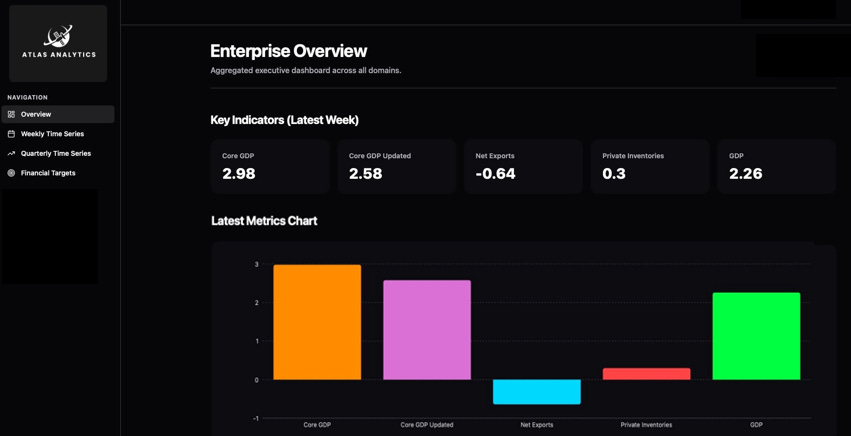
Today we’re also excited to share a preview of the next evolution of Atlas Analytics.
Our new client portal delivers our economic intelligence directly to customers through an interactive dashboard.
The executive overview provides continuously updated macroeconomic indicators, including Core GDP, inventories, net exports, and headline GDP, in a single interface.
Clients can also explore economic performance geographically through our new state-level forecasting dashboard.
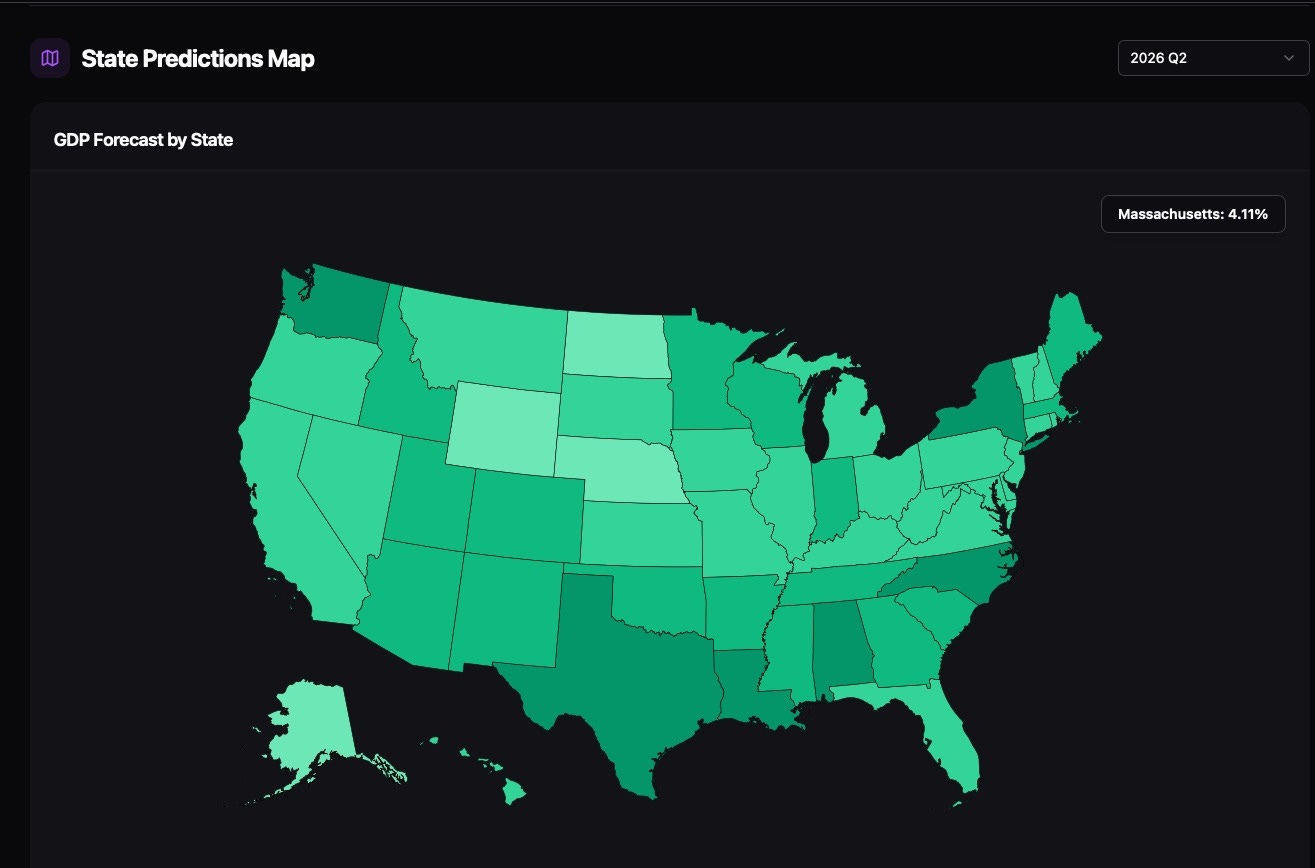
Every U.S. state receives its own GDP forecast, allowing investors, corporations, and policymakers to identify regional divergence long before official statistics become available.
This is only the beginning.
Future releases will include:
Historical forecasting revisions
Weekly economic updates
Asset-level intelligence
Security-level insights
Client-specific custom dashboards
Our objective is simple:
Move macroeconomic intelligence from quarterly reports to continuous decision support.
The Future of Economics
For decades, economists have accepted a simple constraint:
You cannot know the economy until after it has already happened.
Satellite imagery changes that.
Machine learning changes that.
Geospatial intelligence changes that.
The future of economics isn’t faster spreadsheets.
It’s observing economic activity directly.
Official statistics will always remain important.
But increasingly, they will become confirmation—not discovery.
At Atlas Analytics, that’s the future we’re building.
And this quarter, it arrived three months early.