

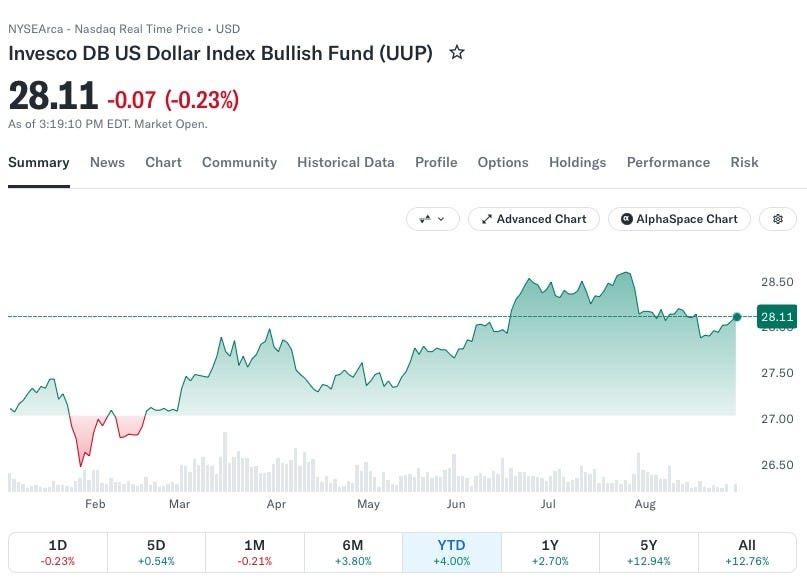
In May, Atlas wrote that the dollar was primed for a breakout, arguing that persistent inflation would keep U.S. interest rates higher than markets expected and, in turn, support a stronger dollar.
The Federal Reserve hasn’t raised rates yet. The dollar has moved anyway.
The Invesco DB U.S. Dollar Index Bullish Fund (UUP), our preferred proxy for the dollar, is now up approximately 4% year-to-date.
And following Federal Reserve Chairman Kevin Warsh’s hawkish Jackson Hole speech last week, the case for higher U.S. interest rates, and a stronger dollar. has only strengthened.
The question now isn’t whether the May thesis has begun to play out. It’s whether the move has further to run.
We think it does.
Why Do Higher Interest Rates Likely Mean a Stronger Dollar?
At its core, the relationship between interest rates and currencies is about where investors can earn the highest return on their money.
When U.S. interest rates rise relative to those in other major economies, dollar-denominated assets become more attractive. An investor choosing between otherwise comparable U.S. and European assets, for example, has a greater incentive to hold the U.S. asset when it offers a higher yield.
But to buy U.S. Treasuries, corporate bonds, or other dollar-denominated assets, investors generally need dollars.
That creates additional demand for the currency.
The key, therefore, isn’t simply whether the Federal Reserve raises interest rates. It’s how U.S. rates evolve relative to rates elsewhere, and how investors expect that gap to change.
This is why expectations matter so much. Currency markets don’t wait for the Federal Reserve to actually change the federal funds rate. If investors become convinced that U.S. rates will remain higher for longer, or rise while other central banks hold steady or cut, the expected return from holding dollar-denominated assets increases today.
That’s precisely the dynamic we’re watching now.
The Fed has yet to raise its benchmark rate, but expectations have shifted toward tighter U.S. monetary policy. If Chairman Warsh follows through on the hawkish message delivered at Jackson Hole, widening interest-rate differentials could provide another source of support for the dollar.
Why Should Warsh Hike?
Two weeks ago, we argued that the bond market is already sending the Federal Reserve a message: monetary policy may not be tight enough.
Despite the Fed holding its benchmark rate at 3.50%–3.75% at its July meeting, long-term borrowing costs have continued to rise. The 10-year Treasury yield recently climbed to roughly 4.7%, its highest level since January 2025. Mortgage rates have risen, corporate borrowing has become more expensive, and financial conditions have tightened even without another move from the Fed.
Why?
Part of the answer is inflation. Core PCE inflation remains above the Federal Reserve’s 2% target, while renewed energy-price pressures threaten to keep inflation elevated. Investors increasingly appear to be pricing the risk that inflation will remain persistent, and that today’s policy rate may ultimately prove insufficient to bring it back to target.
But inflation isn’t the only concern. Large federal deficits have increased the supply of Treasury securities just as foreign investors account for a smaller share of the market. At the same time, investors are demanding greater compensation for the uncertainty associated with holding long-term government debt.
The result is an important divergence: the Fed has paused, but the bond market hasn’t.
As we wrote in The Bond Market Is Telling You the Fed Should Raise Rates, Treasury markets continuously incorporate expectations about inflation, growth, fiscal policy, and monetary policy. Rising long-term yields therefore suggest that investors are demanding tighter financial conditions than they were only a few months ago.
Chairman Warsh now faces a choice. He can wait for inflation to return convincingly toward 2%, or he can respond to a market that is already signaling that rates may need to remain higher, and perhaps move higher still.
We think the balance of risks favors another hike.
What Could Make Us Wrong
No macroeconomic forecast is certain. While we believe the balance of risks points toward higher interest rates and a stronger dollar, there are several developments that could undermine our thesis.
First, economic growth could deteriorate faster than expected. Atlas’s satellite-based macroeconomic forecasts are already pointing toward a slowdown in U.S. growth. So far, however, we don’t believe that deterioration is severe enough to mandate a rate cut. If incoming data were to show a much sharper contraction, particularly alongside a substantial deterioration in the labor market, the Fed could be forced to prioritize growth over inflation. Rate cuts would substantially weaken our dollar thesis.
Second, inflation could surprise meaningfully to the downside. August Core PCE will be an important test. A particularly soft reading could give the Fed greater confidence that inflation is returning toward its 2% target and reduce the case for another hike. We think that’s possible, but unlikely enough that it doesn’t change our base case today.
Third, even a Fed hike may not be enough. Currency values depend on relative interest rates, not simply the direction of U.S. rates. If other major central banks tighten more aggressively than the Federal Reserve, the yield advantage of dollar-denominated assets could narrow, or even move against the United States. In that scenario, we could be right about the Fed and still be wrong about the dollar.
Finally, politics and Treasury policy could complicate the signal coming from bond markets. The administration has sought to influence longer-term borrowing costs through changes in Treasury issuance and other policy levers. So far, those efforts have not been sufficient to prevent long-term yields from remaining elevated. But a more successful effort to push down the long end of the Treasury curve could weaken one of the pillars supporting our outlook.
For now, none of these risks is enough to overturn our base case. We continue to expect tighter U.S. monetary policy, and thus believe the dollar has further room to run.
Work With Us
Satellite-based macroeconomic forecasting isn’t just about GDP.
Atlas uses proprietary machine-learning and satellite-imagery models to measure economic activity from above. We are currently taking on a select number of projects to explore how these capabilities can be applied to specific industries, assets, and investment questions.
Have a use case where better real-time economic visibility could matter? Reach out to connect.